
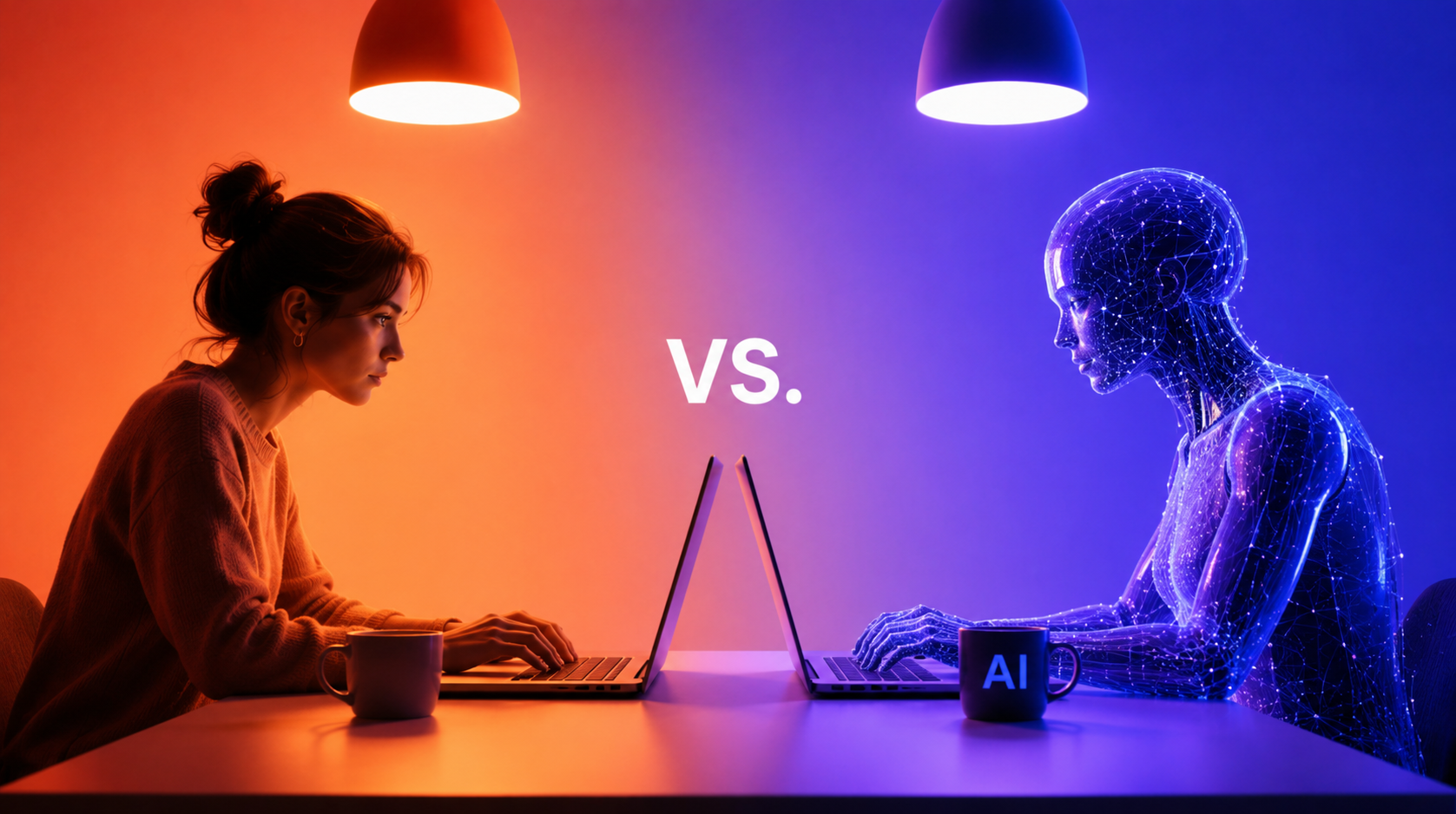
AI can create content in seconds. Give it a product, an audience and a few prompts, and voilà: headlines, articles, ads, social posts and 15 variations before you’ve finished your coffee. Pretty impressive. But there’s a slightly more important question: Does anyone actually want to read it?
A new study suggests that when human copywriters go head-to-head with generative AI, humans still have the upper hand.
And not by a tiny margin.
Humans 1 – AI 0
As part of the Tactics & Takeaways 2026 trend report, Globe Content Studio – the content studio behind The Globe and Mail – conducted a series of controlled A/B tests on Meta.
Human-written ad copy was tested against copy generated by Meta AI and Microsoft Copilot.
The results?
Human copywriter: 3.03% CTR / $0.30 CPA
Meta AI: 2.14% CTR / $0.39 CPA
Microsoft Copilot: 1.70% CTR / $0.42 CPA
In other words, the human-written ads generated more clicks at a lower cost. Turns out the robots haven’t taken our jobs just yet. But the interesting part isn’t really who “won”. It’s why.
Welcome to the age of AI slop
There was a time when AI-generated content felt new. Now? Open LinkedIn, scroll through your feed, check your inbox. Chances are you’ll encounter something that feels suspiciously… AI. Perfectly structured sentences. Predictable headlines. Lots of words like “unlock”, “navigate” and “ever-evolving landscape”. Technically correct, perfectly polished – and completely forgettable.
There’s even a name for the endless stream of low-quality AI-generated content now flooding the internet: AI slop. And consumers appear to be getting tired of it.
According to Tactics & Takeaways 2026, only 26% of consumers say they prefer generative AI content over traditional content. At the same time, the share of consumers who believe AI has negatively affected the creator economy increased from 18% in November 2023 to 32% in July 2025.
That’s quite a shift.

When everyone can create content, creativity matters more
Here’s the strange thing about AI.
It has made creating content easier than ever. Which has also made it easier than ever to create bad content. Anyone can generate 20 LinkedIn posts before lunch. Anyone can create an ad campaign in minutes. Anyone can produce a perfectly polished article without spending hours staring at a blinking cursor.
So we’re getting more content. Much, much more content. But more doesn’t necessarily mean better.
And nowhere is that more important than in B2B.
B2B buyers aren’t looking for another 800-word article telling them that AI is “transforming the business landscape”. They’re looking for expertise, answers to difficult questions, real experiences, original data, and a point of view they haven’t already read ten times.
Research from Adobe puts it rather neatly: B2B buyers don’t need more content. They need content that is more relevant and timely. Yet 69% of B2B marketers say they feel pressured to rapidly increase both the number and variety of digital assets they produce.
And that’s where the AI content explosion creates an interesting problem. If everyone can produce more content, faster and cheaper than ever before, more content is no longer much of a competitive advantage. Better content is.
Even B2B marketers don’t completely trust AI content
That doesn’t mean B2B marketers aren’t using AI.
Quite the opposite. According to Content Marketing Institute, 81% of B2B marketing teams use generative AI tools.
But here’s where it gets interesting.
Only 4% of B2B marketers report a high level of trust in generative AI output. And just 17% describe the quality of AI-generated content as very good or excellent.
So, we’re using AI. A lot. We’re just not entirely convinced by what it gives us.
And perhaps that tells us something about where AI fits into content marketing. AI is very good at helping us produce. But producing something and creating something worth reading aren’t necessarily the same thing.

B2B buyers are using AI. But they still want humans.
The same contradiction is appearing on the buyer side.
B2B buyers aren’t rejecting AI. In fact, it’s quickly becoming part of how they research potential suppliers.
A 2026 Gartner study found that 45% of B2B buyers had used generative AI when researching vendors and products. But when it came to trusting what they found? 69% preferred to validate AI-generated insights with a sales representative.
That’s an interesting distinction. AI is becoming part of how people find information. But expertise, credibility and human judgment still matter when they’re deciding what to believe.
And for B2B marketers, that matters.
Because B2B content has never simply been about filling a website with articles or keeping the company LinkedIn page busy.
Good content builds expertise. It answers the questions your customers are actually asking. It demonstrates that you understand their problems. And ultimately, it gives them a reason to trust you.
Your experts might be your biggest advantage
This is where B2B companies have something AI doesn’t.
People who actually know stuff.
Engineers who have spent 20 years solving the same problems your customers are struggling with. Salespeople who hear the same questions in meeting after meeting. Consultants who know why the obvious solution often doesn’t work. Product specialists who can explain something Google – or ChatGPT – can’t.
That knowledge is incredibly valuable.
And in a world where anyone can generate a generic article about almost anything in seconds, it may become even more valuable.
The challenge for B2B marketers isn’t simply to produce more content with AI. It’s to turn the expertise that already exists inside the organization into content people couldn’t get from AI in the first place.
Authenticity is becoming a strategy
We can already see a similar shift happening in consumer marketing.
After years of increasingly polished digital content, some brands are deliberately putting human craftsmanship back in the spotlight.
Porsche, for example, recently highlighted the process behind a campaign combining hand-drawn animation with 3D technology – from rough sketches all the way to the finished film.
That’s interesting. Because a few years ago, “perfect” was often the goal. Now that AI can produce technically polished content at the click of a button, perfection isn’t nearly as impressive as it used to be.
The process matters. The ideas matter. The person behind the work matters.
And while a B2B whitepaper is obviously very different from a Porsche commercial, the underlying principle is surprisingly similar. Give people something only you could have created.
Your experience. Your expertise. Your customers. Your data. Your perspective.
That’s a lot harder to replicate with a prompt.
But wait. Wasn’t AI supposed to make us more productive?
Yes. And it can.
AI is incredibly useful for research, brainstorming, summarising information, analysing data, creating variations and getting past that dreaded blank page.
But there’s a difference between using AI to support creativity and outsourcing creativity to AI.
And perhaps that’s what all these numbers are really telling us.
The opportunity for B2B marketers isn’t to use AI to produce as much content as possible. It’s to use AI to free up more time for the things that actually make content valuable. Talking to customers, interviewing experts, finding the interesting angle, developing an opinion, thinking, creating.
You know. The human stuff.

Human or AI? Why not both?
So, should we stop using AI? Of course not. That would be a little awkward coming from us. We use it. We like it. And used well, it can make content marketing considerably more efficient.
But AI works best as a tool – not as a replacement for the people, expertise and ideas that make your company different.
The future of content probably isn’t human or AI. It’s humans who know when to use AI – and, just as importantly, when not to. Because if everyone has access to the same tools, the tool itself isn’t your competitive advantage.
What you do with it is.



That’s us
Now we're curious about you.
What do your business needs look like, and what can we do to help? We look forward to hearing from you!